
Last week I asked Google a question a commercial real estate lender might ask: average debt yield for Phoenix industrial in 2026.
The AI Overview answered without hesitation. Debt yield in the Phoenix industrial market typically ranges between 9% and 11%, it said, with a citation chip next to it pointing at Apartment Loan Store and two other sources. Specific number. Specific metro. Specific year. A source attached. It looked like exactly the kind of answer the whole industry is now optimizing to be inside of.
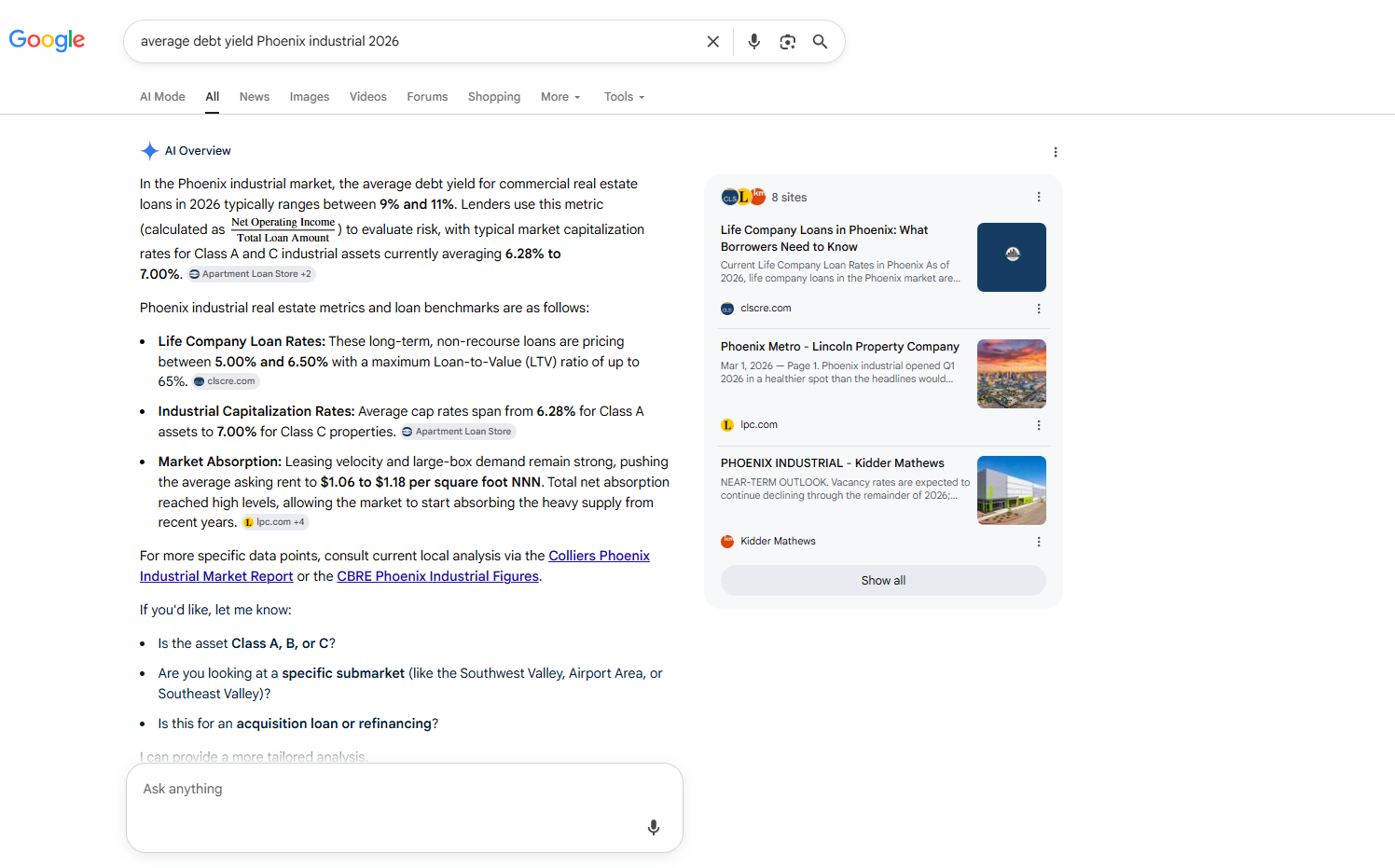
I captured this in early June 2026. AI answers vary from run to run, so the live query may surface different sources now. That variance is part of the point.
So I clicked the citation.
The cited page did not contain the number
Apartment Loan Store has a Phoenix page. It is a clean, real page with a cap rate table by property type and class, dated to the week I looked at it. I read it. Then I searched it for the words “debt yield.”
Zero matches. The page has cap rates. It has no debt yield at all, for Phoenix or anywhere else.
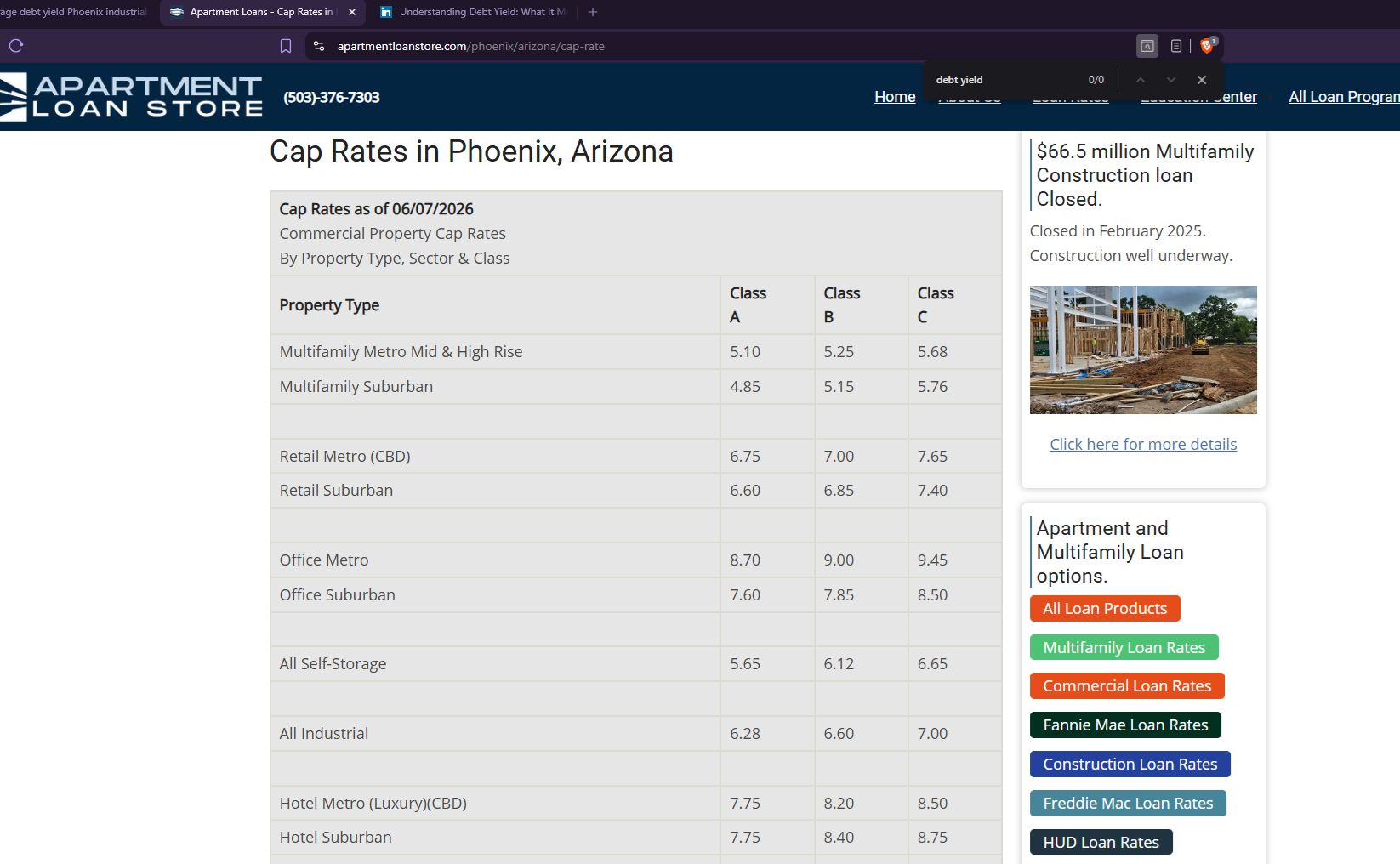
The page Google cited as the source for a debt yield range says nothing about debt yield. So I went looking for where the 9% to 11% actually came from.
Where the number actually lived
I found it in a LinkedIn article by Gantry, published March 2025. It is a general explainer about what debt yield is and why lenders care. Partway down, it lists typical debt yield ranges by property type. Apartments 8 to 10%. Industrial 9 to 11%. Retail 10 to 12%. Office and hotels higher.

There is the 9 to 11%. It is a national rule of thumb for industrial debt yield in general. I searched that article for “Phoenix.” Zero matches. The piece is not about Phoenix, and it is from 2025, not 2026.
So here is what the answer actually did. It took a generic, national, year-old range for “industrial,” relabeled it as “Phoenix industrial 2026,” and attached it to a citation chip for a page that does not contain debt yield at all. Three separate moves away from the truth, presented as one confident sentence with a source.
The number was real somewhere. It was just not Phoenix, not 2026, and not in the page that got the credit.
There is a cost hiding in that, and it does not land on Google. It lands on Apartment Loan Store, whose name now sits next to a number their page never published. I call this the hallucination tax: the reputational cost a brand pays when an engine confidently attributes a wrong claim to it. The brand did nothing and gets cited for something false. For a company whose buyers make financial decisions on these numbers, that is not a small thing.
Two things that look identical from the outside
I do not think this happened because the engine is broken. It happened because no page actually owns the answer to that question. When a query has no clean source, the engine assembles one from whatever is adjacent, and the citation it attaches is the closest thing it found, not the thing that contains the claim.
That gap is the whole difference between two kinds of work that look the same from a distance.
One kind optimizes a page so it might get pulled into an answer. Better structure, faster load, more backlinks, the things that have always made a page rank. Useful work. I am not against any of it. But notice what it cannot tell you. It cannot tell you whether the answer the engine built was correct, or which specific claim your page won, or whether the citation next to your brand points at a page that actually backs the claim.
The other kind starts from the claim. It asks which exact questions a buyer asks, which of those have no real source yet, and what verifiable number you could publish that would make the engine stop assembling and start citing. It checks, after publishing, whether the cited page contains what the answer says. Most of the time, nobody checks that. I checked it on a query I had no stake in and found a fabricated-but-sourced number in about four minutes.
When someone tells you they do GEO, that is the thing to ask them to show you. Not a dashboard of how many times a brand appeared. The actual answer, the actual citation, and whether the cited page says what the answer claims. The work either survives that look or it does not.
Why the mechanism matters here
The short version is that these engines rewrite your question into smaller ones, retrieve passage-sized chunks to answer each, and attach citations claim by claim rather than page by page. A page wins a citation when it is the lowest-risk way to ground a specific claim. I wrote out the full pipeline separately for anyone who wants the mechanics, in Retrieval, Not Rankings.
The part that matters for the Phoenix answer is this: the engine had no page that owned “Phoenix industrial debt yield, 2026.” So it reached for a national range, dressed it in the specifics of the question, and cited a page that happened to be nearby in topic. A real, current, sourced number on a page built to own that exact question would have given it something better to cite, and the fabrication would have had nowhere to form.
I have watched the opposite case play out on my own data. On ren.ph I publish Philippine BIR zonal values down to the barangay, each figure tied to the specific Department Order and PSGC code it comes from. When someone asks an AI engine for the zonal value of a specific barangay, the answer often cites ren.ph and nothing else, because the number is there, it is specific, and it shows where it came from. The engine does not have to assemble anything. It has a source that owns the claim.
That is the entire game. Not appearing in answers. Being the page the answer cannot be built without.
What to do with this
Next time an AI answer hands you a confident number, click the citation. Open the page it points at. Search that page for the actual figure. You will be surprised how often it is not there.
That four-minute habit is the difference between trusting an answer and knowing whether it holds. It is also, as it turns out, a decent way to tell whether the person you are about to hire for GEO actually does the work, or just knows the word.
Aaron Zara is the founder of Godmode Digital and the engineer behind ren.ph (65,291 verified Philippine real estate data nodes). He holds a PRC real estate broker license and has 18 years of building across digital marketing and business operations.